The traditional product development lifecycle is often held hostage by a fundamental flaw in human psychology: Survey Bias. When asked what they want, users are notoriously unreliable. They answer based on who they wish they were, they seek to please the interviewer, or they simply fail to predict their own future behavior. This creates a “Product Gap”—a distance between what people say in a focus group and what they actually do when they are alone with a screen.
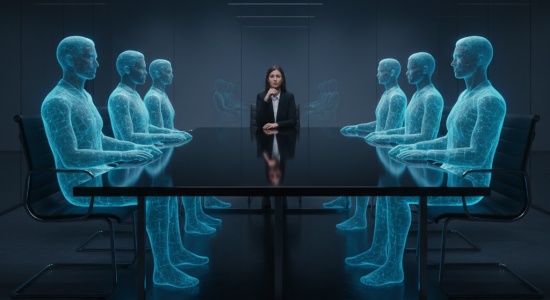
The emergence of Synthetic Stakeholders is closing this gap. By utilizing Large Language Models (LLMs) tuned with deep behavioral data, companies are now creating digital twins of their customer segments. This shift demonstrates the influence of AI by moving product research from the realm of “polite conversation” to the realm of High-Fidelity Simulation.
I. Beyond the Static Persona: What are Synthetic Stakeholders?
For decades, marketing and product teams have used “Personas”—fictional characters like “Marketing Manager Mary” or “Developer Dave.” While helpful, these were static documents that sat in a drawer. Synthetic Stakeholders are the evolution of the persona into an agentic model.
By feeding an LLM anonymized behavioral data, support ticket history, and past purchase patterns, a company can create an AI agent that “thinks” and “responds” like a specific segment of its user base.
- The Interaction: Instead of waiting two weeks to recruit ten users for a focus group, a product manager can “chat” with a thousand synthetic users in minutes.
- The Depth: You can ask these models to perform a task using a new prototype and observe where the “AI brain” experiences friction. Because the model is trained on real historical data, it reflects the frustrations and habits of the actual user base without the social pressure to be “polite.”
II. Eliminating the “Polite Lie”: How AI Removes Survey Bias
One of the most dangerous moments in product development is the “False Positive.” This happens when users tell you they “love” an idea during a survey, leading the company to invest months of development, only for the feature to see zero adoption at launch.
Synthetic Stakeholders eliminate this bias through Unfiltered Response Modeling.
- Emotional Neutrality: An AI model doesn’t care about your feelings. If a feature is confusing, the synthetic persona will fail the task. If a pricing model is unattractive based on the persona’s historical budget constraints, the model will reject it.
- Consistency at Scale: While human focus groups are limited by small sample sizes, AI can simulate thousands of variations. You can test how a feature appeals to a “High-Value Long-Term User” versus a “Free-Tier New User” simultaneously. This allows for a Sensitivity Analysis of demand that was previously impossible.
III. Stress-Testing Features in “Real-Time”
In the traditional cycle, testing happens after something is built. With Synthetic Stakeholders, testing happens during the ideation phase. This is the ultimate “Shift Left” for product strategy.
- Feature Collision Testing: If you introduce a new notification system, how will it interact with the user’s existing habits? Synthetic stakeholders can simulate a “week in the life” of a user, revealing if a new feature becomes an annoyance or a utility over time.
- Pricing and Packaging Simulations: Before announcing a price change, companies can run “Synthetic Market Games.” By letting different AI personas “choose” between different subscription tiers, teams can see where the churn points are likely to occur.
- Edge Case Discovery: Human users in a test usually follow the “Happy Path.” Synthetic users can be programmed to be “stressed,” “impatient,” or “tech-illiterate,” helping teams find UX dead-ends before they reach production.
IV. The Hybrid Future: AI Challenger, Human Navigator
The rise of Synthetic Stakeholders does not mean the end of human research. Rather, it creates a Hybrid Validation Framework.
The AI serves as the “Red Team.” Its job is to find the flaws, challenge the assumptions, and provide the cold, hard data on potential demand. Once the AI simulations have filtered out the obviously bad ideas, human researchers can spend their limited time on the truly nuanced, high-level strategic questions that require human empathy and cultural context.
- Simulation for Breadth: Use AI to test 100 variations of a button, a flow, or a value proposition.
- Human for Depth: Use real people to understand the “Why” behind the “What” once the best variations have been identified.
Investing in Certainty
The most requested “feature” in any boardroom is certainty. While absolute certainty is impossible, Synthetic Stakeholders provide the closest possible approximation. By simulating demand before investing in development, companies are no longer gambling on “gut feelings” or biased surveys. They are making data-driven bets based on the simulated behavior of their own digital twins.
In an era where R&D budgets are under constant scrutiny, the ability to “feel” demand before building is not just a technological advantage—it is a financial necessity. The future of product development isn’t just about building faster; it’s about simulating smarter, ensuring that when a product finally reaches the market, it’s meeting a demand that has already been proven in the digital lab.