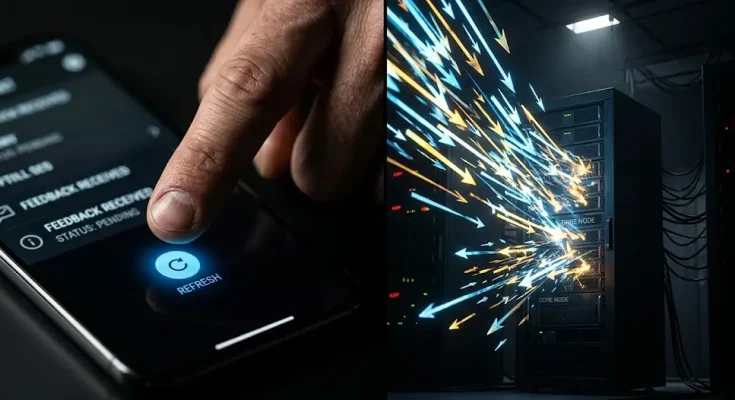
When software slows down, the hardware isn’t the only thing under stress—the person at the other end of the screen is, too. In Stress-Testing the Last Mile, we often forget that the most unpredictable variable is the human user. They don’t think in milliseconds, they think “this isn’t responding.” So they try again. Or they refresh. Or they open another tab. Without realizing it, they’re adding more pressure to the system that’s already struggling.
Ensuring your tech is ready for launch means accounting for these psychological feedback loops. It’s not malicious; it’s just human. But if the system isn’t designed with that in mind, those reactions amplify the problem, turning a minor slowdown into a total blackout.
The ‘Retry Storm’ and the Human-Driven DDoS
User behavior adds another layer that’s easy to forget. When a page takes 600ms instead of 200ms, the user assumes the connection was lost. Each repeat request adds more traffic, which makes things slower, which leads to more repeats. It becomes a loop. If the system doesn’t account for that, it can spiral faster than expected. This is essentially a distributed denial-of-service attack, but it’s coming from your own customers.
Common Panic-Driven Actions:
- Multiple clicks on the “Submit Order” button.
- Constant browser refreshes (F5).
- Opening multiple sessions across different devices to “check status.”
Building Defensive UX
Resilience isn’t just about better code; it’s about better communication. During Stress-Testing the Last Mile, observe how the UI handles delays. Does it show a spinner that lasts forever? Or does it proactively tell the user, “We are processing your request, please don’t refresh”?
Implementing client-side debouncing and disabling buttons after the first click are simple fixes that take massive load off the backend. If the system is designed with human panic in mind, it can withstand much higher traffic than a system that treats every request as a “new” unique action.
Visibility: Logs and Metrics as Survival Tools
When things are under stress, you don’t have time to guess. You need to see what’s happening, quickly. Not just that something is slow, but where exactly it’s slowing down. Logs help, metrics help, but only if they’re actually readable and connected. Otherwise you just get noise, which is almost as bad as having nothing. Visibility is the difference between fixing a bug in minutes or watching the system burn for hours.
“In the heat of a surge, monitoring tells you the patient is sick; observability tells you why.”
Insight from Failure
Testing for this kind of scenario isn’t exactly comfortable. It means pushing the system beyond what feels reasonable and seeing where it starts to bend. Letting parts fail on purpose, just to understand how failure looks. It’s not fun, honestly, but it’s where most of the useful insights come from. There’s also a temptation to over-engineer solutions. Add more layers, more fallback systems, more logic to handle every possible scenario. It works, up to a point. But complexity has its own cost. The more complicated things get, the harder it is to predict behavior under stress.